

TOF-SIMS Time of Flight Secondary Ion Mass Spectrometry

Time-of-flight secondary ion mass spectrometry (TOF-SIMS) is one of the techniques with the highest sensitivity and resolution (spatial and mass) for the chemical analysis of surfaces. The University of Vigo has the only TOF-SIMS system in Galicia. Our TOF-SIMS unit was the first installed in Spain. In 2024, we acquired the most advanced model, unique in Spain and unique in Europe in its configuration and equipment at the date of installation.
The instrument uses charged particles/primary ions that impact the surface of the sample being analyzed. Upon impact, the kinetic energy of the primary ions is transferred to the sample, producing the release or extraction of secondary ions that provide atomic, molecular and isotopic information about the surface of interest.
Among the main advantages of the technique are that it is not necessary to prepare the sample, any solid surface can be analyzed, whether of organic or inorganic origin, it is a NON-DESTRUCTIVE analysis technique in its spectroscopy and mapping variants, it has an extraordinary depth resolution and an excellent spatial resolution.
Advantages
- Studies of all masses on material surfaces; may include individual ions (positive or negative), individual isotopes, and molecular compounds;
- Elemental and chemical cartography at the submicrometer scale;
- High mass resolution, to distinguish species of similar nominal mass;
- High sensitivity for trace elements or compounds, in the order of ppm to ppb for most species;
- Surface analysis of insulating and conductive samples;
- Depth profiles (in the near-surface environment, from the order of individual atomic layers to tens of nanometers);
- Non-destructive testing;
- Retrospective analysis, for post-data acquisition analysis and interpretation of stored images and spectra.
Instrumental Facilities
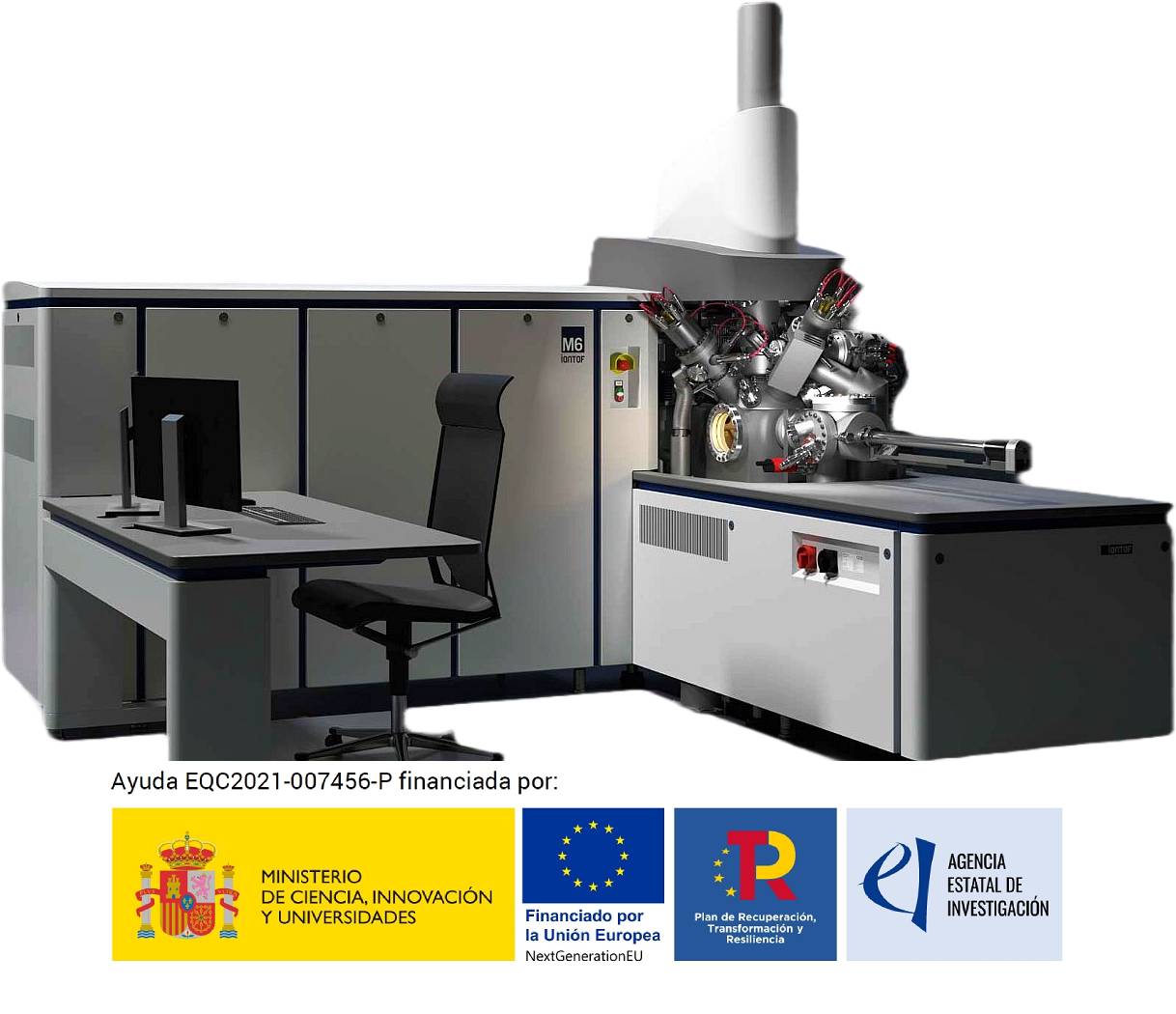
Time of Flight Secondary Ion Mass Spectrometry TOF-SIMS
Instrumentation:
- Time of flight secondary ion mass spectrometer TOF-SIMS, manufacturer: ION-TOF, model TOF-SIMS M6+.
- Integrates scanning probe microscope (SPM) with ultra-high resolution in mass adn imaging.
Technical characteristics
Spatial resolution: Bismuth Polyatomic Gun (Nanoprobe 50) that allows to obtain high spatial resolution (< 50 nm).
Mass resolution: Resolutions > 30000 can be obtained. The reflectron type analyzer allows to resolve mass interferences containing molecules of the CH/13C and CH2/N type, even in high mass ranges, facilitating the identification of peaks.
Mass accuracy/sensitivity: The analyzer with linear mass scale provides a mass accuracy of less than 10 ppm.
Extended Dynamic Range (EDR) means that seven orders of magnitude of dynamic range can be achieved. Mass intensities of 100 ions per pulse can be detected with excellent linearity and reproducibility, avoiding the problem of saturation of abundant ions.
Transmission: Specific delayed ion extraction mode “Delayed Extraction” (DE) for high transmission conditions that allows simultaneously obtaining high spatial resolution and high mass resolution, that is, obtaining mass resolutions over 10,000 in combination with high spatial resolution (less than 50 nm).
Heating and cooling system of the samples. The closed loop cooling system to perform ultra-fast and efficient processes, reducing the consumption of liquid Nitrogen. Range -100 °C to 500 °C.
Argon ion Gas Cluster Ion Beam (GCIB) analysis for specific spectrometry of organic and biological samples both at the surface and in depth profiles. The cluster size can be varied from 500 to 10,000, with an ion energy of up to 2 eV per atom, conditions that allow to preserve intact molecular information.
High current dual source ion column (DSC) for all inorganic depth profiling applications. The column is equipped with two sources, an electron impact source that can operate with O2, Ar or Xe and a thermal ionization cesium (Cs) ion source.
Charge compensation system with low-energy electrons, to neutralize surface electrostatic charge.
MS/MS capability, to differentiate molecules at the same nominal mass, obtaining the mass spectra of each molecule while avoiding interference in the fragmentation pattern of both molecules.
AFM system, for profile calibration and obtaining three-dimensional images. Own AFM camera.
Vacuum: The System has more than 20 turbomolecular pumps that allow a vacuum to be obtained in the AC (residual) analysis chamber in the range of 10-10 mbar and 10-8 mbar in the Load Lock LL (pre-chamber).
Applications
Polymers and Organic Materials
- Identification of additives, antioxidants and stabilisers.
- Mapping of the distribution of different phases in polymeric mixtures.
- Analysis of plasticiser migration to the surface.
- Detection of molecular contaminants at trace level (ppm/ppb).
Semiconductor devices
- Ultra-high resolution depth profiling of dopants.
- Failure analysis of thin film adhesion failures.
- Detection of metallic contamination in manufacturing processes.
- Characterisation of materials for OLED and flexible displays.
Life Sciences and Medicine
- Molecular imaging of cells and tissue sections.
- Localisation of drugs and their metabolites within biological structures.
- Analysis of lipids and fatty acids in cell membranes.
- Evaluation of surface functionalisation in biosensors.
Surface and Coating Science
- Characterisation of self-assembled monolayers (SAMs).
- Analysis of coupling agents (silanes) in fibres.
- Study of cleaning and lubricant residues on mechanical parts.
- Investigation of corrosion mechanisms in initial stages.
Geology and Cosmochemistry
- Measurement of isotope ratios in minerals.
- Analysis of cosmic dust particles and meteorite samples.
- Trace element mapping in complex geological samples.
Nanotechnology
- Analysis of the surface chemistry of functionalised nanoparticles.
- Characterisation of carbon nanotubes and 2D materials (graphene).
- Study of the internal structure of nanostructured multilayers.
Sample requirements
- The samples must be in good condition and therefore must not contain traces of grease, oils, or any composition that endangers the integrity of the equipment and must be non-toxic or harmful.
- Do not handle the surface of the samples with bare hands. Always wear powder-free nitrile gloves. Our recommendation, in the case of a solid sample, is that before bagging the sample in the plastic bag, it should be protected with aluminium foil (commonly used).
- Samples should be of the appropriate size (dimension) for the technique…Samples exceeding the limits should be cut.It is recommended to contact the technical staff of the Service if there are doubts about the dimensions.
- When the samples are identical on both sides, the user must indicate with a mark the side of interest. If the samples are in powder form, they can be sent in a properly sealed and identified eppendorf vial.
- Samples can be powders, fragments, sheets, solutions, dispersions,
- Any type of sample (conductive, insulating, magnetic, organic, inorganic, powder, solid, viscous) as long as it is compatible with high vacuum, without the need for previous coatings or other specific preparations.
- Non-destructive analysis in spectroscopic and mapped modes
- Analyzed area: 20 μm – 500 μm (Can be extended by means of the stiching option (digital stitching)).
- Depth of analysis from 1 nm
- Upon completion of the work, the samples will be returned to the user in the way is registered on the service form. Samples not delivered to users will be kept at the Service for a stablish period. After this time, the samples will be disposed of as laboratory waste.
More information
Carmen Serra Rodríguez – Tatiana Padín Gómez – Paula Barbazán Martín
+34 986 813 882 – Fax: 986 812 135
cserra@uvigo.es – tatiana.padin@uvigo.es – pbarbazan@uvigo.es