

Mass Spectrometry
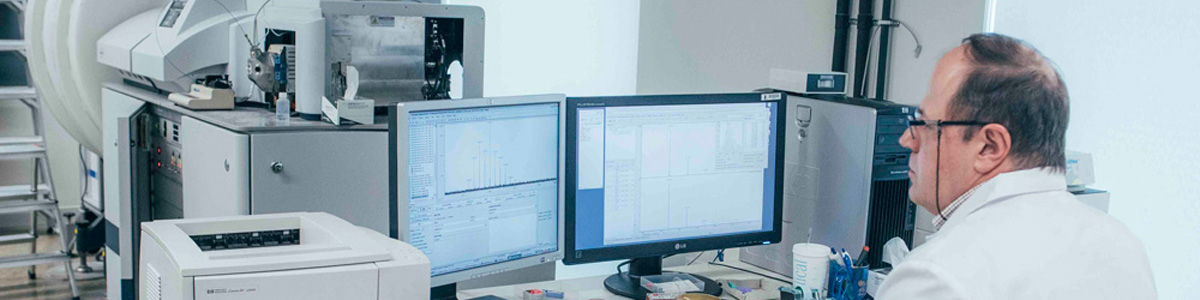
The Mass Spectrometry unit comprises:
Mass spectrometry is an analytical technique based on the chemistry of ions in the gaseous state. As in many other analytical techniques, the basic purpose of a mass spectrometer is to convert the sample into measurable products that indicate the structure of the original molecule. In this case, the products formed are gaseous ions whose masses and relative abundances constitute the mass spectrum. As can be deduced from the brief description above, the technique would, in principle, have the disadvantage of being destructive, although given the high sensitivity of the detectors used, a 1 mg sample is usually sufficient to provide the molecular mass of a compound, also providing structural and quantitative information.
The adaptation of mass spectrometry with a chromatographic technique (especially gas chromatography) dates back to the 1970s. This adaptation revolutionized the analysis of complex mixtures of organic compounds because it combines the high resolving power of gas chromatography with the high sensitivity of the adapted mass spectrometer. The development of capillary columns in the 1980s further increased the resolving power of gas chromatography and as a result gas chromatography-mass spectrometry (GC-MS) has become the most powerful method for the identification and quantification of relatively nonpolar organic molecules.
Starting in the 1980s and to a greater extent in the 1990s, EM has played an increasingly important role in the biological sciences, as two new ionization methods have been developed: Electrospray (ESI) and matrix assisted laser desorption/ionization (MALDI). They allow the measurement of the molecular masses of proteins, oligosaccharides and DNA.
Instrumental Facilities
Bruker FTMS SolariX XR Mass Spectrometer
Equipped with:
- Shielded horizontal superconducting magnet with a field of 7 Teslas.
- Dual ESI/MALDI Power Supply
- Qq-FTMS hybrid system.
- ParaCell ion cyclotronic resonance measurement cell.
- COMPASS data processing system with MS biotools
Year of acquisition: 2019
Hewlett-Packard 5989 Mass Spectrometer
Equipped with:
- Hewlett-Packard 6890N Gas Chromatograph with Split/Splitless Injector.
- Hewlett-Packard 7683 Automatic Injector.
- Detector de Masas Hewlett-Packard 5975C.
Year of acquisition: 2007
Thermo Mass Spectrometer
Equipped with:
- TRACE1600 Gas Chromatograph with Split/Splitless Injector.
- AL 1610 Automatic Injector.
- ISQ 7610 quadrupole Mass Detector.
- Year of acquisition: 2024
The service currently has the following capillary columns with linked stationary phase:
- HP-5 MS (5% Diphenyl Dimethyl Polysiloxane). Analysis of Alkaloids, Drugs, Fatty Acid Esters, Halogenated Compounds, etc.
- HP-35 (35% Diphenyl Polysiloxane). Analysis of Amines, Pesticides, Pharmaceuticals, etc.
- HP-FFAP (Modified Polyethylene Glycol-TPA). Analysis of Acids, Alkolis, Aldehydes, Acrylates, Ketones, Nitriles, etc.
- HP- INNOWAX (Crosslinked Polyethylene Glycol). Analysis of Alcohols, Aromatics, Essential Oils, Solvents, etc.
MicroTOF-Focus Mass Spectrometer
Equipped with:
- Time-of-flight analyzer.
- Source of ESI.
- APCI Source
- COMPASS data processing system.
- Agilent 1100 HPLC system.
Ano de adquisición: 2020
TimsTOF Mass Spectrometer
Equipped with:
- Time-of-flight analyzer.
- Ionic Mobility System (TIMS)
- Source of ESI.
- COMPASS data processing system.
- HPLC system Bruker Elute.
Year of acquisition: 2020
Applications
High-resolution mass spectrometry is the technique of choice, not only to determine the molecular weight of a substance, but also to determine unequivocally its molecular formula. In addition, the fragmentations to which the molecule is subjected provide us with information, which is often critical to elucidate the structure of unknown compounds. Depending on the configuration of the mass spectrometer, this technique allows applications as diverse as the characterization of polymers by their molecular weight distribution or the investigation of the position of the disulfide bridges of a protein.
The GC-MS technique is widely used in the determination of drugs, poisons, pesticides, etc. and is the legally recommended analysis procedure for narcotics analysis in the USA and anti-doping control by the International Olympic Committee.
AREAS OF INTEREST
- Organic Chemistry
- Physical Chemistry
- Inorganic Chemistry
- Analytical Chemistry
- Pharmacology
- Toxicology
- Food Technology
- Biology
- Biochemistry
Sample requirements
The amount of sample necessary to carry out an experiment is minimal, and it is recommended that to avoid unforeseen events, a quantity of at least 2 mg of product be delivered to the service.
More information
Manuel Marcos – Nieves Atanes
+34 986 813 884