

X-ray Powder Diffraction
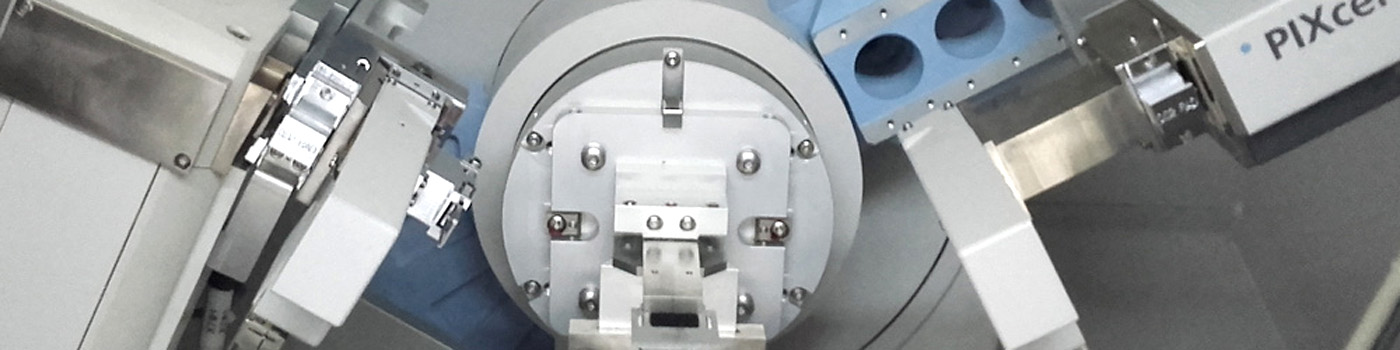
The X-ray diffraction unit consists of two diffractometers.
X-ray Diffraction Spectrometry studies materials through the deflections that a monochromatic beam of X-rays undergoes when it strikes them. The deflection angles are closely related to the distance between the planes of the material’s crystal lattice. Therefore, the diffraction pattern of a substance is characteristic of the arrangement or ordering of the atoms that compose it.
This technique provides a convenient and practical method for the qualitative identification of crystalline compounds.
The intensity of the diffraction lines is a function of the concentration of the substance, making quantitative analysis feasible.
The main advantage of diffraction analysis is that, being a non-destructive method, it distinguishes compounds or atomic groups, not individual atoms, which provides data that would be difficult or impossible to obtain by other methods. It allows the analysis of a wide range of materials such as metals, minerals, polymers, catalysts, plastics, pharmaceuticals, thin film coatings, ceramics and semiconductors. The fundamental application of X-ray diffraction is the qualitative identification of the mineralogical composition of a crystalline sample.
The measurement modes available in the service are:
- Mode theta-2 theta
- Grazing angle mode
Instrumental Facilities
X’Pert Pro Diffractometer (PANalytical)
- X’Pert Pro Diffractometer (PANalytical)
- Fixed or programmable automatic slots
- Graphite Monochromator
- Equipped with two additional configurations:
- High resolution (Xermanium primary monochromator)
- Grazing incidence (parabolic primary collimator crystal in incident beam and long beam in diffracted beam)
Applications
It allows the analysis of a wide range of materials such as metals, minerals, polymers, catalysts, plastics, pharmaceuticals, thin film coatings, ceramics and semiconductors. The fundamental application of X-ray diffraction is the qualitative identification of the crystalline phases of a sample.
Sample requirements
The samples must be solid and crystalline. They must be dry. Powdered samples will be placed in a sample holder, but there are also samples that can be measured directly.
Type of samples: They can be powders such as minerals, waste, synthesis products, soils, rocks, etc. Or solids, such as coatings, alloys, metals, plastics, etc.
Dimensions: Powders with a particle size ≤ 20µm
Solids with a maximum size of 3*3 cm² ( other sizes available upon request) and thickness between 3 and 20 mm.
Required quantity: for powders 1g except for clays which require 5g (consult clay treatment).
Sample collection time: 1 month
More information
| Jorge Millos | Estefanía López | Alberto Acuña Couñago |
| 986 130125 986 130127 | 986 130124 | 986 813885 |
| jmillos@uvigo.es | fani@uvigo.es | berto@uvigo.es |