
Raman Spectroscopy
The Sustainable Development Food Security Service has within the materials characterization unit the Raman technique that can provide structural and compositional information on a wide number of samples.
Raman spectroscopy is a photonic technique that provides chemical and structural information about organic or inorganic materials in a few seconds. It is based on the elastic scattering, or Raman scattering, of monochromatic light, which generally comes from a laser in the visible, near-infrared, or near-ultraviolet range. The Raman effect occurs when light strikes a molecule and interacts with the electron cloud of the atoms of that molecule. The light from the illuminated spot is collected with a lens and sent through a monochromator. The wavelengths close to the laser line, due to elastic Rayleigh scattering, are filtered out, while the rest of the collected light is scattered in a detector.
For the molecule to exhibit the Raman effect, a change in molecular polarizability, or the amount of deformation of the electron cloud with respect to the vibrational coordinate, is necessary.
Obtaining the Raman spectrum will allow us to study the vibrational modes of the molecules present in the sample. It offers the advantage that there are modes that are not active in the infrared but are active in Raman.
Instrumental Facilities
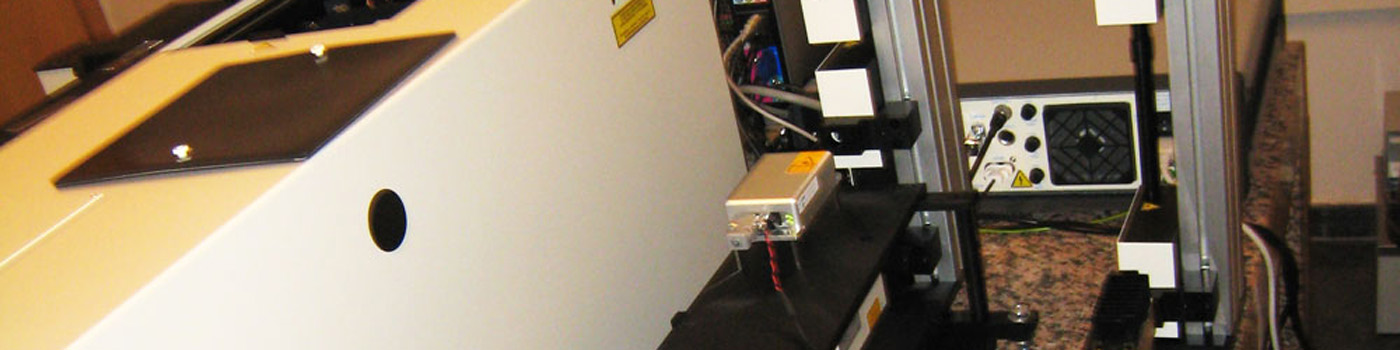
Horiba Jobin Yvon HR800UV Spectrometer with ultraviolet lasers from:
- Ar: 488 nm (azul)
- Ar: 532 nm (green)
- Diode: 785 nm (red)
- HeNe: 633 nm (red)
The equipment has a confocal microscope with three different objectives: 10x, 50x and 100x and an integrated video camera that allows the visualization of the sample. The detector is an air-cooled CCD (1024×1056 pixels of 26 microns) suitable for UV, visible and near infrared.
Applications
Through this technique, which is non-destructive, we can measure a wide variety of samples such as polymers, emulsions, coatings, biomolecules, soils, contamination, pictorial materials, waste or archaeological samples, and almost all types of organic or inorganic materials.
It is also of great use in gemology, in the study of composition, crystallinity and homogeneity of semiconductor materials, and in the study of biological tissues.
Sample requirements
Solid, powder or liquid samples can be analyzed. The thickness of the solids must be small because focusing with the microscope is required.
Metals or metal alloys cannot be analyzed.
Raman spectroscopy is performed directly on the material to be analyzed, so the samples do not need any type of preparation or alteration of their surface.
More information
| Jorge Millos | Estefanía López | Alberto Acuña Couñago |
| 986 130125 986 130127 | 986 130124 | 986 813885 |
| jmillos@uvigo.es | fani@uvigo.es | berto@uvigo.es |