

ICP-MS Cuadrupolar
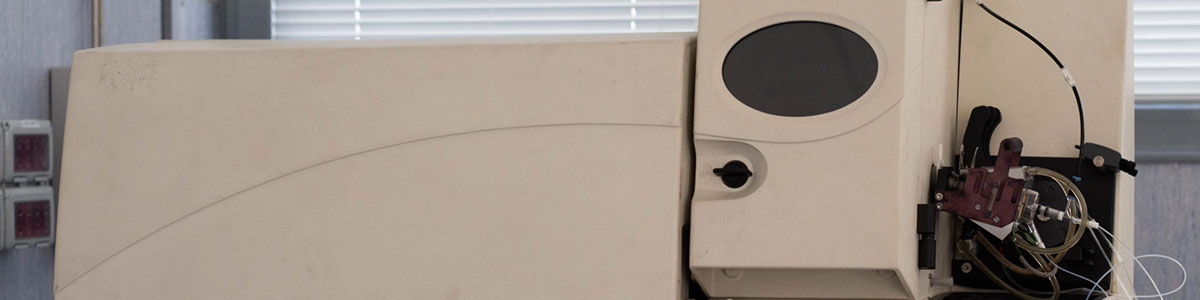
ICP-MS (Inductively Coupled Plasma – Mass Spectrometry) is the acronym for Inductively Coupled Plasma Mass Spectrometry. The plasma is formed with an argon flux that passes through a radiofrequency field where it is maintained in a state of partial ionization.
In this technique, samples are decomposed into their elements in a high-temperature argon plasma and analyzed based on the mass/charge ratios of the elements. Four main processes can be considered: sample introduction and generation of an aerosol, production of ions and other species by the high-temperature argon plasma source, extraction of the ions from the plasma and separation based on their mass/charge ratio, and detection system for them.
Some of the advantages of the ICP-MS technique are its multielemental analysis capability and its low detection limits for a wide variety of elements. It allows elemental analysis at trace and ultratrace levels. It allows the analysis of aqueous solutions for most elements, with the exception of halides and some metals, with detection limits ranging from ng/L to mg/L, depending on the element and the sample matrix.
It also allows the determination of elements forming volatile species (As, Se, Sb, Ge, Bi and Hg) by using the generation of hydros as a system for introducing the sample into the plasma.
The determination of the following elements by ICP-MS cannot be carried out: H, He, C, N, O, F, Ne.
As polyatomic interferences poden ser attenua por media da utiliza da celda de collision/arécindo empregando como gases helio e/ou hidroxeno
O ICP-MS pode ser couplelo a un sistema de Cromatografía Líquida de Alta Presión (HPLC) para a speciación de arsenico ou otros analítos.
The ICP-MS analysis technique finds applications in a large number of fields: water (drinking, waste, natural, etc.), geology, metallurgy, food, medicine, etc.
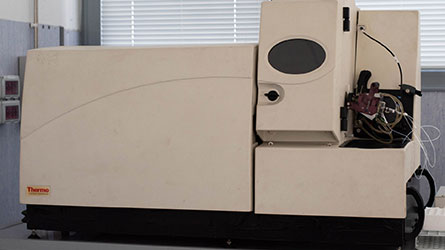
Instrumental Facilities
– X Series ICP-MS (Thermo Elemental)
-Cetac ASX-520 Autosampler
Characteristics:
Quadrupole ICP-MS
Collision/reaction cell with helium and hydroxene
Possibility of using the equipment in self-service. Consult service conditions.
Applications
- ICP-MS will be used in cases where trace or ultratrace level analysis (ppb or ppt) is required, whether in drinking water, wastewater or in acid digestions of solids, or in the analysis of elements whose determination is difficult or impossible using other methods.
- The ICP-MS analysis technique finds applications in a large number of fields: water (drinking, waste, natural, …), geology, metallurgy, food, medicine, etc.
Sample requirements
Aqueous solution samples:
- Samples will be provided in aqueous solution (auga Milli-Q), acidified to 2% with HNO3 .
- The reagents used must be of quality for analysis of metals at trace and ultratrace levels.
- They cannot contain precipitates or suspended solids; otherwise, they must be filtered to 0.45 µm .
- Samples containing HF cannot be analyzed, since this acid damages the internal parts of the equipment.
- The acids HCl and H2SO4 should be avoided in the treatment of samples that contain elements that form polyatomic interferences .
- Samples to be analyzed are delivered in 10-15 ml or 50 ml falcon-type tubes, numbered sequentially.
- The total dissolved solids content must not exceed 1000 ppm (0.1%, e.g. 0.1 g in 100 ml of solution) in order to avoid clogging of the nebulizer and interface cones.
- It is advisable to attach a reagent blank or sample preparation.
- The concentration of the analytes of interest should be around ppb, if the concentration is much higher it should be indicated to take the necessary actions.
Samples without preparing:
- Food samples (fish, juices, oils, etc.), plant or animal tissues, soils, sludges, steels, alloys, etc., that arrive unprepared for the determination of elements by ICP-MS, will require acid digestion in order to be measured. This digestion can be carried out in microwaves or in savillex reactors, depending on the type of sample, and may be more or less complex. In this case, the user must contact the Instrumental Analysis Service to specify the appropriate treatment.
- Users who wish to recover samples already analyzed will have a maximum of one month from the date the results were sent, after which the samples will be eliminated.
More information
Jorge Millos – Rosa Mª Lomba
+34 986 81 22 38 – +34 986 13 01 26