

ICP-OES
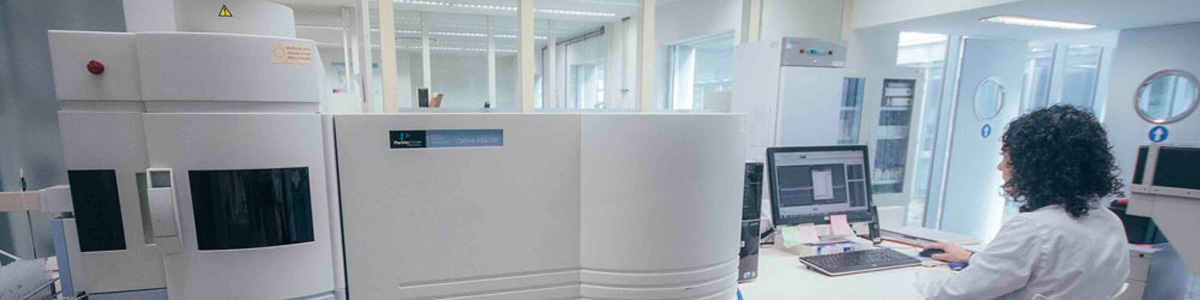
ICP-OES stands for Inductively Coupled Plasma Optical Emission Spectrometry. It allows the quantitative determination of almost all elements of the periodic table.
The sample in aqueous solution is mixed with a stream of argon and broken with the help of the nebulizer into small droplets forming an aerosol. The elements present in the aerosol are conducted into an argon plasma generated by the ionization of the argon itself subjected to a radiofrequency field. The temperature of the plasma is 10000 ºC, at these high temperatures most of the elements emit light at a characteristic wavelength. A system of lenses, diffraction gratings and prisms separates the light into different wavelengths that are detected by a diode array, this type of detector allows the detection of many analytes simultaneously. The number of photons that reach the detector is proportional to the concentration of the analyte.
In terms of sensitivity, it can be compared to flame atomic absorption, although detection limits are typically found in aqueous solutions at levels of μg/L.
Instrumental Facilities
Simultaneous ICP tabletop spectrometer with vertical torch, a purged echelle polychromator and a charge injection device array detector (CID).
- 4-channel peristaltic pump to allow the use of advanced accessories.
- Free-running, solid-state 27.12 MHz RF generator to ensure robust plasma generation for any sample matrix
- Three independent MFCs to precisely control the nebulizer, plasma, and auxiliary gas and ensure long-term stability.
- The option to add an additional gas to the plasma through an integrated MFC with a flow rate of 0-0.25 L/min. This allows the analysis of samples with high salt content (up to 30% TDS) or organic samples.
- Drain sensor to shut down the system if a leak is detected in the sample path and to prevent sample loss
- A thermostatically controlled echelle polychromator to ensure long-term stability and reduce the need for recalibration
- A cross-dispersion prism combined with an echelle to provide 7 pm resolution and minimize interference
- Random access CID image generator providing full wavelength coverage from 167.021 to 852.145 nm
- An improved UV mode to allow for better sensitivity and detection limits for elements between 167.021 and 240.063 nm through a second focused UV exposure
- Software-tunable auxiliary gas MFC, adjustable between 0.0 and 2.0 LPM.
- Detector type: High-performance solid state CID821
- Nebulizer Gas MFC tunable via software and adjustable between 0.0 and 1.5 LPM.
- Peristaltic pump 4-channel pump, adjustable between 0 and 125 rpm
- Plasma Gas MFC tunable via software and adjustable between 0.0 and 20.0 LPM.
- Radial vertical de PlasmViewing
- 27 MHz RF power supply, adjustable between 750 and 1600 W.
- Spectral bandpass 7 pm to 200 nm
- Echelle simultaneous spectrometer
- Wavelength range 167 to 852 nm
Possibility of using the equipment in self-service. Consult conditions with the Service staff.
Applications
- Sensitive quantification of more than 70 metallic elements in gaseous, liquid and solid samples, in macrocomponent and trace concentrations
- Environmental control: water, soil, sediment
- Food control: macronutrients and micronutrients. Legislated levels of toxic metals
- Quality control of materials: cements, metal alloys, food
- Toxicological analyses of blood and urine due to ingestion or poisoning by metals
Sample requirements
- A maximum number of 50 samples is accepted in each service form.
- Aqueous solutions
- Preferably acidified with 2% HNO3
- Leaked
- Maximum content in total dissolved solids (TDS) 2000 ppm
- Minimum quantity required 10 ml, arranged in 15mm diameter tubes
- Identification of samples with consecutive numbers
- Samples containing hydrofluoric acid will not be accepted, as they damage the internal parts of the equipment.
- If the extracts are different from HNO 3, 100 ml of extractant are required. Please indicate this fact in the form service and contact with the Service staff.
More information
Jorge Millos – Rosa Mª Lomba
+34 986 812 238 – 986 813 885