

Inductively Coupled Plasma Mass Spectrometer (ICP-MS)
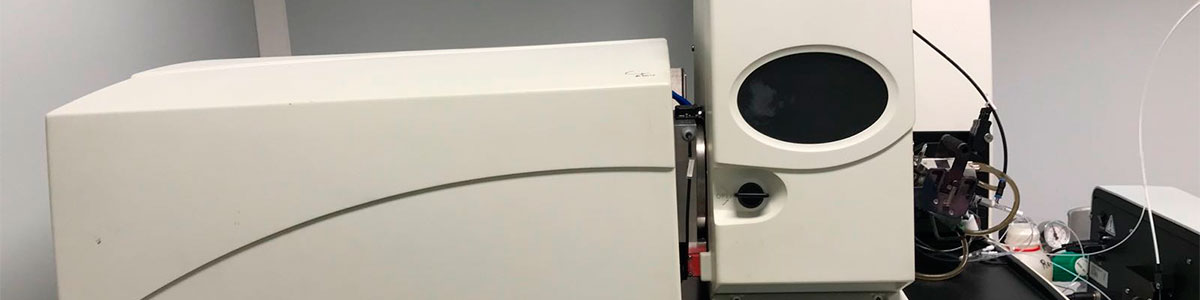
Inductively coupled plasma is an ionization source at atmospheric pressure. The sample is introduced into an argon plasma where atomization and ionization of the elements take place according to their ionization potential. ICP plasma mainly produces positive and monoatomic ions (M+) that are introduced into the mass spectrometer for analysis.
ICP-MS can detect most elements and isotopes in the periodic table at very low levels quickly, unequivocally, and with minimal sample pretreatment.
To eliminate polyatomic interference, a collision/reaction cell using a mixture of helium and hydrogen is used.
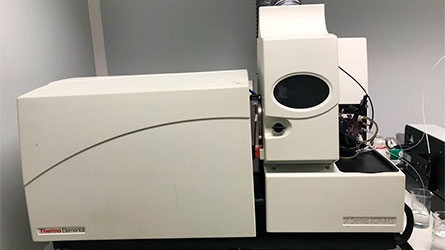
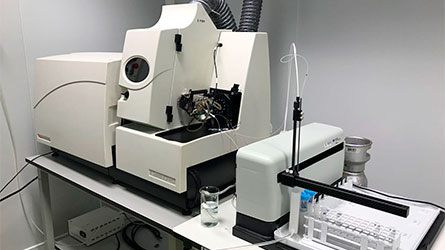
Instrumentation
Quadrupole ICP-MS X series system.
Applications
- Quality control of finished products.
- Characterization of raw materials.
- Environmental control: impurities in drinking water and wastewater, contaminants in water, quantification of toxic and hazardous waste, soil and sediment analysis, food analysis, etc.
- Toxicological analysis of blood and urine.
Sample requirements
- Samples must be correctly identified and numbered sequentially.
- They must be in solution and filtered through a pore size of at least 0.45 µm.
- Solid samples require acid digestion to put the analytes of interest into solution.
- H2SO4 and HCl acids should not be used to avoid polyatomic interference.
- Samples containing HF cannot be analyzed (as they can damage the equipment), so HF must be removed from the samples beforehand.
- The total dissolved solids content of the samples must not exceed 0.2% to prevent clogging of the nebulizer.
- In addition, the approximate concentration of the elements in the sample must be indicated if it was necessary to dilute it.
More information
Cristina Pérez Novo – Sandra Gil Casal
+34 988 387 414