

Contact Angle
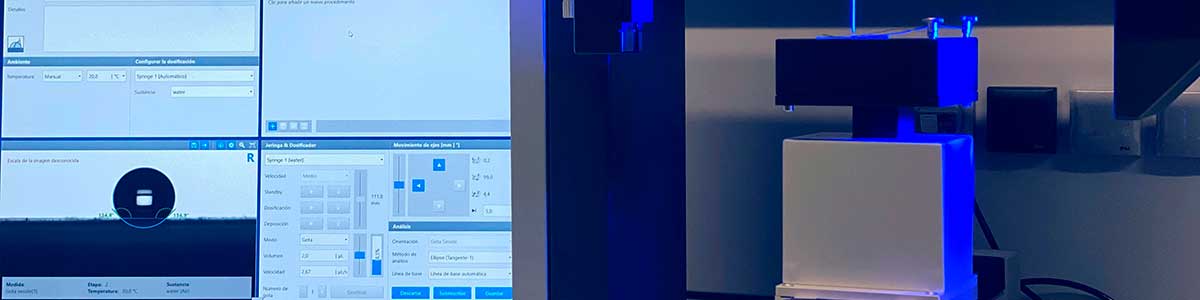
The characterization of solid surfaces and liquids plays an important role in the understanding of the phenomena of adhesion, wettability, biocompatibility, lubrication of solid surfaces, and the absorption of liquids. The measurement of the contact angle and surface tension provides the necessary information for the characterization of liquid/solid surface interactions.
The contact angle is the angle formed by a liquid at the point of liquid/gas/solid contact. The shape of the droplet arises from the three interfacial tension forces. The contact angle is a quantitative measure of the wettability of a surface by a liquid. It is also used to control the quality of a surface treatment and surface cleaning. It is also used to observe the effect of modifications on surfaces, either by treatments or by deposition of films of other materials or molecular layers.
The unit has two instruments, one recently acquired, advanced and completely automated, the DSA-100E manufactured by KRÜSS, and the other the See System E, which is a completely manual system, with limited technical characteristics, for measuring contact angle and surface energy, an instrument developed and produced at Masaryk University in Brno (Czech Republic) during the years 2002-2006.
Equipamento instrumental
DROP SHAPE ANALYZER DSA 100E, MANUFACTURER: KRÜSS
Technical Characteristics
- Sample table with three movable axes, samples must not exceed a size of 320 mm x 275 mm. Motorized Platform: “x”, “y” and “z” axes controlled by software.
- Range: x-axis length: 100 mm, y-axis length: 100 mm and z-axis length: 38 mm.
- Resolution: x-axis: 10 μm, y-axis: 10 μm, z-axis: 10 μm. Precision: x-axis: 100 μm, y-axis: 100 μm, z-axis: 100 μm.
- Illumination: High-power monochromatic LED type. Wave length, dominant 470 nm. Light field 46 mm × 46 mm (D × H)
- Video system with camera, optical system, prism, light source and aperture. Manual focus: Zoom 7X, Viewing angle ±4, Field of view CF04: from 3.9 mm × 3.9 mm to 24.7 mm × 24.7 mm, Resolution of CF04 optics: from 3.1 to 21.7 μm
- Camera: high-speed CF06, USB 3.0 connection, Resolution 640 × 480 px, Image frequency 3400 fps, Dark noise 10.5 electrons, Dynamic range 56.6 dB
- Dosing system: software controlled (4×) + manual (1×). Glass cartridge/syringe (volume) (450 μL), disposable (3 mL), Resolution 0.1 μL, Speed 0.02 to 25 µL/s
- Sesile Drop: contact angle (CA): Range from 0 to 180° (software based). Resolution 0.01° (software based). Accuracy 0.1° (based on instrument). Models: conical section, polynomial, circle, Young-Laplace, height-angle, Advancing type: backward, static, dynamic
- Pending Drop: Interfacial tension (IFT)/surface tension (SFT). Range 0.01 to 2000 mN/m (software based). Resolution 0.01 mN/m (software based). Young-Laplace models. Types: static, dynamic
DROP SHAPE ANALYZER “SEE SYSTEM E” MANUFACTURER ADVEX INSTRUMENT
Technical Characteristics
- Small portable instrument connected via USB 2.0 port
- Robust aluminum body
- 2 MP (1600×1200) UVC camera with high-resolution glass lens
- Sample table up to 10×10 cm, horizontally movable in 2D
MEASUREMENT METHODS
- Static contact angle
- Advance and retreat contact angle
- Contact angle using a bubble in a liquid
- Sliding angle
- Surface free energy (SFE) according to the following models: Owens-Wendt-Rabel-Kaelble (OWRK), Fowkes, Extended Fowkes, Van Oss & Good (Acid-Base), Schultz, Wu, Zisman, Equation of state
- Position-dependent contact angle and SFE
- Surface tension of a liquid and interfacial tension between two liquids
- Adhesion work, solid/liquid interfacial tension, coefficient of expansion
Applications
The contact angle is a parameter used in materials to characterize their wettability properties. The measurement of the contact angle is therefore important, especially in biomaterials. It also serves to observe the effect of modifications on surfaces, either by treatments or by deposition of films of other materials or molecular layers.
- Quality analysis and optimization of activation processes such as plasma treatment, flame treatment, or corona treatment before coating or adhesion
- Analysis of the wettability of plastics, glass, ceramics, wood, paper, or metal
- Analysis of the effectiveness of hydrophobic and other coatings
- Analysis of coating liquids and adhesives and evaluation of their adhesion
- Evaluation of the long-term stability of coatings
- Analysis of (super)hydrophobic and self-cleaning surfaces
- Analysis of the homogeneity of cleaning and wettability and measurement of differences between coated/uncoated or treated/untreated zones
- Analysis of wettability at controlled temperature and/or humidity
- Measurement of the surface tension of hot liquids
Sample requirements
The samples must be in good condition and therefore must not contain traces of grease, oils, or any composition that endangers the integrity of the equipment and must be non-toxic or harmful.
Do not handle the surface of the samples with bare hands. Always wear powder-free nitrile gloves. Our recommendation, in the case of a solid sample, is that before bagging the sample in the plastic bag, it should be protected with aluminium foil (commonly used).
Samples should be of the appropriate size (dimension) for the technique…Samples exceeding the limits should be cut. It is recommended to contact the technical staff of the Service if there are doubts about the dimensions.
When the samples are identical on both sides, the user must indicate with a mark the side of interest. If the samples are in powder form, they can be sent in a properly sealed and identified eppendorf vial.
Upon completion of the work, the samples will be returned to the user in the way is registered on the service form. Samples not delivered to users will be kept at the Service for a stablish period. After this time, the samples will be disposed of as laboratory waste.
More information
Carmen Serra Rodríguez – Tatiana Padín Gómez – Paula Barbazán Martín
+34 986 813 882 – Fax: 986 812 135
cserra@uvigo.es – tatiana.padin@uvigo.es – pbarbazan@uvigo.es