

Multi Sensor Core Logger-Standard (MSCL)
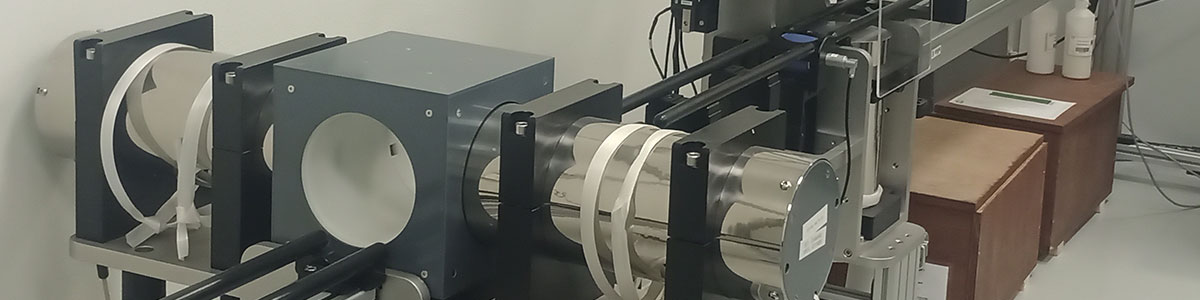
The Multi Sensor Core Logger-Standard (MSCL-S) is a core scanning equipment that allows the analysis of different physical properties at high resolution in an automatic and rapid manner, allowing the study of changes in density, P-wave transmission, magnetic susceptibility, color, resistivity and natural radioactivity throughout the sample in a non-destructive manner. It also allows the acquisition of high-resolution optical images.
The analysis of the raw gamma density of samples is based on the determination of the attenuation suffered by gamma rays emitted by a source after passing through the sample under study and reaching the detector.
The determination of P-wave velocity is based on the analysis of the propagation of P-waves through materials.
Magnetic Susceptibility analysis is based on determining the degree to which a low-intensity alternating magnetic field generated by an oscillator increases or decreases as a result of the presence of the sample.
The determination of color by visible spectrophotometry is based on the measurement of the astral reflectance (total, or including the specular component) of the sample.
The determination of electrical resistivity is based on measuring how strongly a material opposes the flow of an electric current. The electrical resistivity module consists of a transmitting coil and a receiving coil. The first induces a high-frequency magnetic field in the sample, which causes electric currents in it, and the second measures the magnetic fields generated by the induced electric current.
The determination of natural gamma radioactivity is based on the identification of certain radioisotopes present in the sample based on the characteristic energy of the gamma rays they emit. The module consists of two natural gamma radioactivity detectors for the determination of gamma rays emitted due to the spontaneous decay of the radionuclides present, in particular, K-40, U-238 and Th-232. In the case of U and Th, secular equilibrium is assumed in their respective series.
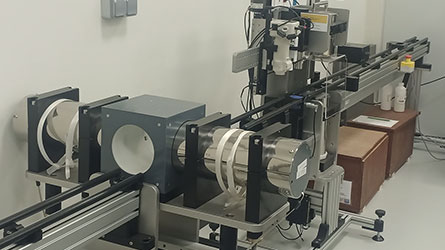
Instrumental Facilities
- Gamma ray module
- P-wave transducers
- Magnetic Susceptibility Sensors
- Bartington MS2E point sensor
- Sensor de bucle Bartington MS2C
- Konica Minolta CM-700d Spectrophotometer
- Electrical resistivity module
- Natural gamma module
- Geoscan imagin system
Applications
- Determination of the raw gamma density of the samples. From this measurement, the fractional porosity of the sample can be estimated.
- Determination of P-wave velocity. If raw gamma density and P-wave velocity are determined, the acoustic impedance of the samples can be calculated.
- Determination of Magnetic Susceptibility (SM)
- Determination of color using visible spectrophotometry: Color data can be obtained on the L*a*b* (CIE), RGB, and Munsell scales
- Determination of electrical resistivity
- Determination of natural gamma radioactivity
- Obtaining high-resolution optical images: Optical image data can be exported to numerical data in RGB scale
Very useful in the analysis of sedimentary and rock samples.
Sample requirements
- Sedimentary cores (open), U-channels or rock cores up to 1.50 m.
- A request will be made for each testimony.
- Samples will be delivered to the Core Scanning Laboratory (Floor -2, CACTI Tower Annex). Please check with the Service to confirm sample reception hours.
- In the case of sedimentary core analysis, applicants must provide empty PVC jackets and caps (similar to those of the samples) for the preparation of calibration samples for the different sensors.
- Sample collection period after analysis: 1 month.
More information
Jorge Millos – Paula Álvarez
+34 986 81 22 38 – +34 986 81 39 68 (Laboratorio de escaneo de testigos)
jmillos@uvigo.es – palvarez@uvigo.es