

Liquid Chromatography
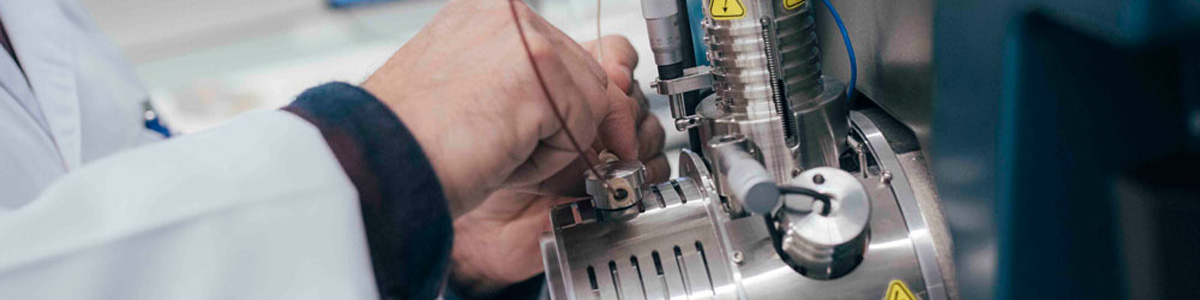
High-Performance Liquid Chromatography is a widely used technique for the separation and characterization of complex mixtures due to its versatility, and also due to its wide field of application in all branches of Science.
The components of the sample, previously treated and dissolved, are introduced into a suitable eluent (mobile phase), and by applying high pressures they are forced through a chromatographic column (stationary phase). This produces a selective retention of the analytes, and the resolution of this separation depends on the interaction of these with the stationary phase and the mobile phase. The separation can be optimized by varying the mixtures or composition of the mobile phase, as well as the nature of the column packing.
We can classify Liquid Chromatography as a second or separation method:
- Liquid, solid or adsorption: Adsorption on the surface of the stationary phase
- Liquid: Distribution between liquid phases, one mobile and one stationary
- Bound phase: Partition and/or adsorption between the mobile and bound phases
- Affinity: Use of immobilized ligand structure to bioselectively bind the desexed protein.
Once separated, the compounds are detected using a specific detector, generating a characteristic signal that depends on both the type of compound and its concentration. The graphical representation of the signal versus the retention time of the compounds is called a chromatogram.
Instrumental Facilities
Liquid Chromatographs:
- WATERS 2695 Separation Module
- AGILENT TECHNOLOGIES 1260 INFINITY
- DIONEX ICS-3000 Ion Chromatograph
- HEWLETT PACKARD 1050 SERIES
Detectors and accessories:
- Detector MS/MS AB SCIEX Triple Quad 3500
- Detector Photodiode Array WATERS 996
- Detector UV-VIS HEWLETT PACKARD 1050 SERIES
- WATERS 474 Fluorescence Detector
- WATERS 410 Refractive Index Detector
- Agilent 1200 Series Refractive Index Detector
- Dionex Conductivity Detector
- Dionex Amperometric Detector
- WATERS Fraction Collector III
- PolyScience Thermostatic Bath
- Thermostatic furnaces WATERS
- WATERS post-column pumps
Applications
Among many applications we can highlight (contact with technical staff):
- Synthesis and purification: obtaining purer compounds so that they can be used later (final stage of many syntheses)
- Pharmaceutical products: antibiotics, sedatives, steroids, analgesics…
- Biochemistry: amino acids, proteins, carbohydrates, lipids…
- Nutrition: artificial sweeteners, antioxidants, additives…
- Contaminants: pesticides, herbicides, phenols, PCBs…
- Clinical medicine: bile acids, drug metabolites, urchin extracts, estrogen…
- Forensic chemistry: drugs, poisons, blood alcohol, narcotics…
- Separate and detect the most commonly determined ions in the periodic table using Ion Chromatography
- Determination of inorganic contaminants by Ion Chromatography
Sample requirements
- Make a Service Request in the LIMS system and deliver the samples duly identified with your request.
- Minimum sample quantity required: 0.5 mL (consult us)
- Maximum number of samples per request: 10 (exceptions in Ion Chromatography)
- Injection volume: 1-100 µL
- Filtration if possible: 0.45µm
- Deadline for collection of measured samples: 1 month
- Refrigeration of analyzed samples: 1 week after delivery of results
More information
| Jorge Millos | Alberto Acuña | José Gómez |
| +34 986 812 238 | +34 986 813 885 | |
| jmillos@uvigo.es | berto@uvigo.es | josegomez@uvigo.es |