
MAT 253
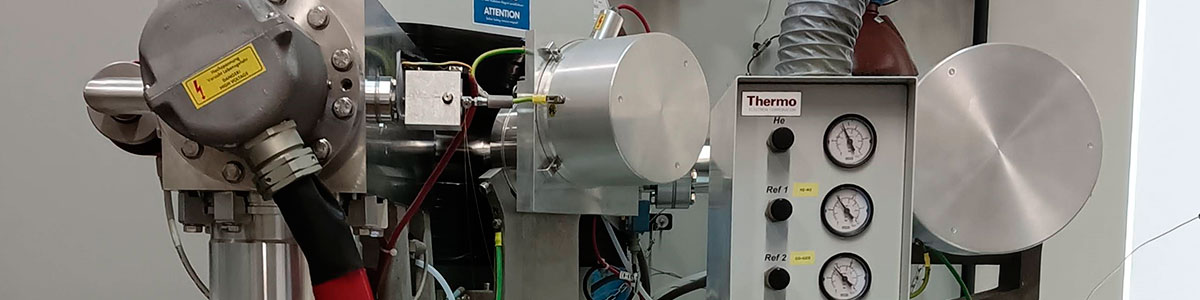
The technique basically consists of determining the relative abundances of the different stable isotopes of a given element, which in this particular case, expresses itself as relative abundances of an isotope respecto doutro (2H/1H, 13C/12C, 15N/14N, 18O/16O).
The analytical method is based on the combustion of the sample (solid or liquid). The gases generated are transported to the ion source. Here, the different ions are generated by the impact of electrons in a high voltage current. The ions are then accelerated and focused through electrostatic lenses to form a beam that passes to the detectors.
Instrumental Facilities
- IRMS Thermo Finnigan MAT 253
- FlashEA 1112 Series Elemental Analyzer
Applications
The determination of the isotopic composition in samples of water, oil, coal, rocks, sediments, minerals, food, etc., can provide useful information in hydrological, hydrogeological, mineral deposit, global change and paleodiets studies, as well as in biological studies, medical diagnosis and on food adulteration.
Sample requirements
- Samples can be solid or liquid, homogeneous and representative of the material.
- In the case of unground samples, grinding will be marked on the service request.
- The amount of sample required is 1-5 mg for solid samples.
- Samples must come in perfectly closed and identified plastic or glass containers.
- The maximum number of samples per service request is 30.
- Users who wish to do so will have one month to collect the measured samples at the service.
More information
Jorge Millos – Jesús Éstevez Sío
+34 986 812 238, +34 986 130 128