

Atomic absorption
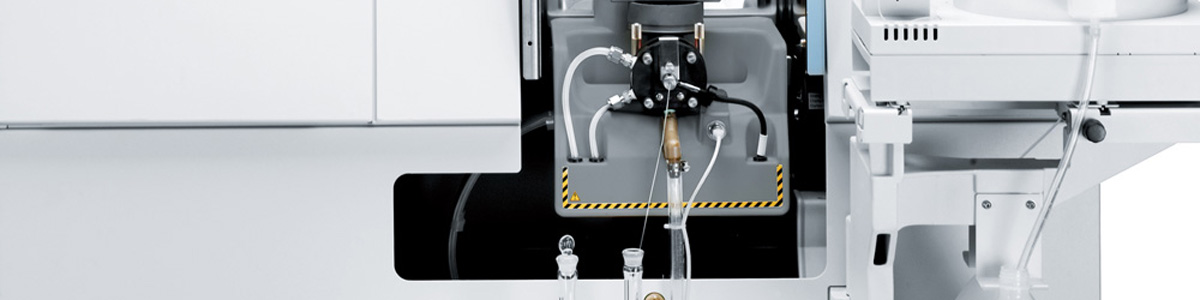
Atomic Absorption Spectrophotometry is used in the determination of chemical elements, especially cations. The analyte of interest must be in aqueous solution. This solution can have a natural origin or can be the result of the acid attack of substances originally in a solid state in order to disintegrate their atoms and put them in solution.
The aqueous sample is transformed into atomic vapor by different processes, this atomic vapor contains free atoms (and ions) of the analyte that will absorb the light radiation emitted by a lamp in the spectrum of interest of the analyte. The difference between the radiation emitted by the lamp and that which finally reaches the detector is related to the absorbance by the Beer-Lambert Law:
A= εLC
Donde:
A = Absorbance (dimensionless)
ε = specific absorptivity coefficient (L mg-1 cm-1).
L = Length of the measurement path (cm).
C = Concentration, in this case in mg/L.
Considering the process of transforming aqueous samples into atomic vapor, we classify the Atomic Absorption Spectrometry techniques into:
- Flame Atomic Absorption Spectrophotometry: the aqueous sample is nebulized and introduced into a linear flame that has a temperature in its center of 2000-3000ºC, first the solvent evaporates (desolvation), leaving small solid particles that tend to dissociate into individual atoms or gaseous elemental ions to form atomic vapor.
- Electrothermal Atomic Absorption Spectrophotometry (Graphite Furnace): in this case the atomic vapor is obtained by depositing about 10 to 20 microliters of sample in a graphite tube that is heated to 2500 ºC, at this temperature the atomic vapor is formed. It has greater sensitivity than flame atomization, in the order of µg/L (ppb).
- Cold Vapor Atomic Absorption Spectrophotometry: it is only possible to use it to determine mercury (Hg) because it is the only element that can be passed from aqueous solution to the gaseous elemental state by means of a simple chemical reduction and dragging it out of the solution using a current of an inert gas such as argon. It has little matrix interference and very good sensitivity in the order of µg/L (ppb).
Instrumental Facilities
Atomic absorption spectrophotometer: Perkin Elmer SpectrAA-800
- Real-time beam bending optical system
- Operational range of 190 to 900 nm
- Positions for eight lamps compatible with hollow cathode or electrode discharge lamps
- Deuterium lamp background correction system
Electrothermal atomization atomic absorption spectrophotometer: Perkin Elmer SpectrAA-800
- Background correction for Zeeman effect
- Operational range of 190 to 870 nm
- Positions for eight lamps compatible with hollow cathode or electrode discharge lamps
- Automatic sample injector
Flow spectrometer for mercury determination: Perkin Elmer FIMS 400
- Compact equipment intended exclusively for the determination of Hg using the cold vapor technique
- Automatic sample introduction via peristaltic pump
- Detection limit lower than 1 µg/L
Applications
- Sensitive quantification of more than 60 metallic elements in gaseous, liquid and solid samples, in macrocomponent and trace concentrations
- Quality control of materials: cements, metal alloys, food
- Environmental control: water, soil, sediment
- Toxicological analyses of blood and urine due to ingestion or poisoning by metals
Sample requirements
- To be in aqueous solution, the minimum quantity required is 25 mL.
- Filtered and well covered.
- Acidified preferably with 2 % HNO3.
- In the case of complex matrices or extracts, the technician must be contacted, and in some cases it is necessary to include a 100 ml fraction of extractant for standard preparations.
- Submit the samples together with the analysis request form, which will specify the elements to be determined.
- Specify the technique with which the analytes are to be determined or, where applicable, the precise quantification limit. Failing this, the simplest analysis will be used.
- If the samples are for mercury determination, they must be refrigerated.
- The maximum total dissolved solids (TDS) content cannot exceed 2000 ppm.
- Samples containing hydrofluoric acid will not be accepted, as they damage the internal parts of the equipment.
More information
Jorge Millos – Rosa Mª Lomba
+34 986 812 238 – 986 813 885