
Infrared spectroscopy
Infrared Spectroscopy is based on the absorption of IR radiation by molecules. In this technique, the chemical bonds of the molecules absorb infrared radiation of sufficient energy to cause a vibrational transition in the molecule, thereby modifying its vibrational state. The symmetry of the molecule is the most important factor in determining the frequency and amplitude of the molecular vibration. For a vibrational mode of a molecule to be active in the IR, there must be a change in the dipole moment during it.
On the other hand, there is a relationship between the measured spectral signal and the concentration of the molecule of interest in the sample, which is given by the expression A=aCl, where A is the absorbance, a is the molar absorptivity, C the concentration in the optical path.
The infrared analysis service belongs to the materials characterization unit. We have infrared spectroscopy by transmission, by ATR and infrared microscopy in a wide range of wavelengths.
The service does not have the means to measure gases using this technique.
Instrumental Facilities
Espectrómetro FTIR Nicolet 6700 (Thermo), and coupled to this an ATR with Smart Orbit diamond crystal and the Nicolet Continuum Microscope . Equipped with three detectors (DTGS KBr, DTGS polyethylene and MCT) and two types of beam splitter (KBr and Solid substrate) depending on the measurement range, it allows measurements in the far and mid infrared. This equipment can be used in self-service after taking a specific training course.
NIRQUEST 512 spectrometer (Oceans Optics)with HL-2000-CAL haloxene tungsten source and InGaAs detector suitable for the 850-1700 nm range. Equipped with QR400-7-VIS-BX reflection and backscatter probe, TP300-VIS-NIR liquid transmission probe. An ISP-50-8-R-GT integrating sphere is also available. This equipment is portable and can be used in self-service outside the CACTI facility (Consult the technician).
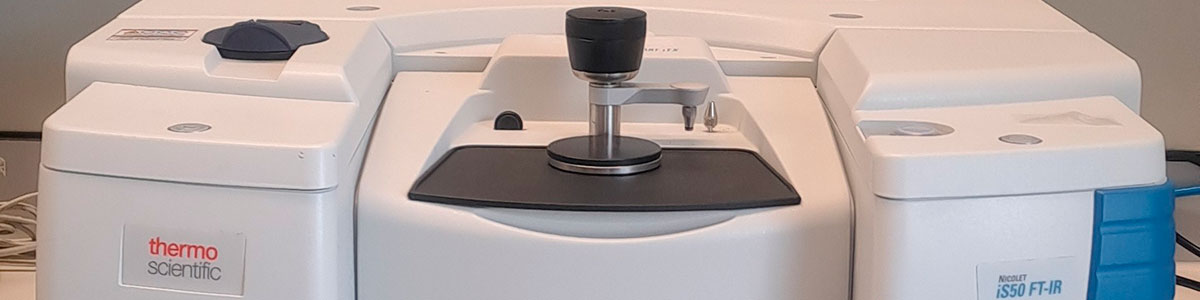
FTIR-RAMAN Nicolet iS50
The Nicolet iS50 FTIR spectrometer, which features a highly flexible design, can be upgraded from a simple benchtop FTIR instrument to a fully automated system with a multispectral range that can acquire from far infrared to visible spectra.
ACCESSORIES:
- Built-in diamond ATR with mid and far IR capability.
- Raman accessory in the sample compartment: The iS50 Raman accessory offers functionalities such as mapping and well plate detection analysis in a module mounted for the sample compartment.
Applications
The usefulness of this technique lies in the possibility of carrying out the structural and compositional characterization of both pure and impure solid or liquid samples. It allows the identification of functional groups present in the sample, and can be applied to solid and liquid substances.
In the mid-infrared zone, fundamental vibrational modes of a large number of chemical bonds can be detected (CH, NH, CO, C=O, SO, Si-O, Al-O, OH, SH, Si-H…). The far region (FAR) is useful for locating metal-O, metal-N, metal-S, and metal-halide vibrational modes of inorganic and organometallic compounds. The near field (NIR) is used for the study of overtones and fundamental molecular vibration combination bands of C=O, CH, NH, SH and OH bonds, of great interest in agriculture, pharmacy and food.
Among the most common applications we have the characterization of biological molecules (proteins, carbohydrates, lipids), characterization of synthesis products, identification of polymer types, presence of contaminants or impurities, calculation of the degree of similarity between two or more samples…
Sample requirements
Transmission:
- Samples that can be measured: Dusts (particle size ≤ 10µm) or solids that can be ground
- Thick layers (1µm) deposited on silicon
- Liquids: oils, dispersions, solutions, etc.
ATR:
- Samples that can be measured: Powders (particle size ≤ 10µm) or solids that can be ground
- Flexible solids (plastics, fibers, pastes, etc.)
- Slightly flexible solids with a flat surface
- Some coatings (>50µm)
- Liquids: oils, dispersions, solutions, etc.
Transmission or reflection by microscope:
- Samples that can be measured: Solids: rocks, plastics, fibers, coatings, residues on surfaces, pastes, inks, varnishes, etc.
- Liquids: oils, dispersions, solutions, etc.
- Powder
- Layer thickness or display: In reflection: 1-50 µm
- In transmission: 5-15 µm
- Maximum display dimensions: 5 x 5 x 0.4 cm
- In the different measurement modalities of this technique, samples containing:
- Strong acids (HCl, H2SO4, HNO3, HClO4)
- Highly oxidizing substances (potassium dichromate solutions)
- Substances that release toxic fumes
More information
| Jorge Millos | Estefanía López | Alberto Acuña Couñago |
| 986 130125 986 130127 | 986 130124 | 986 813885 |
| jmillos@uvigo.es | fani@uvigo.es | berto@uvigo.es |